Scientific Method and Linguistic Agreement

In my last post, I have discussed the The Postulates of Linguistic Agreement. In this post, I will discuss how is it applied to scientific method.

Let’s first considering the following thought experiment.


Assuming someone who believes that before leaving the house everyday, tap the left foot three times will bring good fortune for the day. Then in the following two days two events happened.

  1. On the first day, the person tapped his left foot and left home. He lost a dollar on the side of the road on the way to work.
  2. On the second day, the person didn’t tap his left foot and left home. He found a dollar on the side of the road on the way to work.

Here is his reasoning for justifying his daily ritual: on the first day, the ritual has brought him good fortune, because if he has not performed it, he would have lost more money. On the second day, his failure of performing the ritual has brought him misfortune because he would have found more money if he has tapped his foot in the morning.


Many reader would agree with me on that this person’s belief is a mere superstition, and his reasoning is fundamentally flawed. But regarding why this fictional person’s reasoning is flawed may vary from person to person, and readers would further disagree if ever one of us makes similar mistakes in our everyday reasoning. But here, I will present my thoughts.

Interestingly, in the thought experiments above, the experimenter seems to have employed a scientific method. He controlled variables, in the two days, he has shown that when performs his daily ritual, fortune will follow, while failing to do so, misfortune will trail. So this demonstrates the first point I want to make here:

Scientific method that leads to truth is not just conducting controlled experiments then interprets data.

There are two major errors in the examples above:

  1. The definition of “good fortune” is ambiguous. This has violated the postulates of linguist agreement.
  2. To justify the outcome is “good fortune” or “bad fortune” the experimenter used hypothetical data (or extrapolated data, or fake data), to support his argument. He stated that “because if he has not performed it, he would have lost more money.” for instance. But that is not part of the observation.

In this post I will show how the ambiguity of language can raise problems in experiment designs and how does modern science overcomes that problem. In the example above, the ambiguity of the result or observation of “good fortune” allows the experimenter to retrospectively construct definitions that fits the observation after the experiments has been conducted, which makes all of the experimenter’s claim seemingly true. This fallacy is called “petitio principii” or more commonly mistranslated to “bagging the question”. In this fallacy implies the interlocutor argues the conclusion to be true by assuming it is true in the first place. In this case, because the experimenter retrospectively defined the “good fortune” to fit the observation, he is taking “this observation is good fortune” as part of his premises. Then after, he conclude “the observation is good fortune” as the result of the experiment.

For what we consider real science, such as physics and chemistry, here is the first rule of what makes their methods scientific:

1. The observation/measurement of an experiment must satisfy the postulates of linguist agreement

How physicists established this linguistic agreement, is using standardized measurements. It may sounds complicated, but everyone who has ever used a ruler is familiar with the standardized measurement concept.

Whether it is length, time, voltage, current, etc., all physical quantities are measured using a standard otherwise known as units. When we measure block to be 2 meters, what we mean is that when measured against a standard that we defines as 1 meter, the length of the block is equivalent to two of the standards (1 meter) adds together. From this example, we also see that one of the common uses of numbers is to describe a measured physical property in relationship to the defined standard. Here is how the application of units ensures the postulates of linguistic agreements. To reiterate the two postulates:

  1. For a given property (for example color), if A produces identical symbols in two different measurements, B must also produce identical symbols(though not necessarily identical to A‘s symbols)
  2. For a given property (for example color), if A produces different symbols in two different measurements, B must also produce different symbols(though not necessarily identical to A‘s symbols).

In the example of length, the symbol we produce is a number and a unit (2 m for example). For condition 1, consider two ropes x and y of the same length (say 2 m), no matter who measures the rope or even using a machine, we should get the same number for x and y within the small error margin. Whether it is 2 meters, 6.56 foot, or 78.74 inches, the measurement of the length of x and y should be the same. For the second condition, consider two ropes x and y, now of the different lengths, now the measurements for the length of x and y should be different.

It is not true that all measurements satisfy postulates of linguistic agreements. As the given example of the previous post, our human perception of color is a measurement of color, but it fails to satisfy postulates of linguistic agreements. For a theory to be called scientific, the observation or measurement it uses must satisfies postulates of linguistic agreements. This is a prerequisite to Karl Poppers‘ claim of reproducibility requirement for scientific method. Without agreement of the measurement, the scientific experiment is not reproducible. Considering the following scenario: A chemist describes the outcome of a chemical reaction as green, while another chemist describes the outcome of a chemical reaction as blue. We know that in some culture, the definition of the color green and blue are not identical, so they may actually seeing the same color, but disagree with the result! Similarly, we can see in some cases, the two chemists may actually see different shades of green but conclude that they have the same result.

I want to note here is that I don’t think there is a clear binary between what is scientific method and what is not. As I have noted in my previous post, perfect linguistic agreements is unattainable. Even with extremely accurate instruments, measurements are often subject to errors. Therefore instead of considering scientific method as a toggle switch, we should think of it more as a gradient. The closer linguistic agreement is achieved in measurement, more scientific the method is. Consider the evolution from alchemy to analytical chemistry, with more accurate symbolic representation and understanding of elements introduced to the field, more scientific, the field becomes.

In the next blog post, I will discuss the importance of observability of scientific method. I will try to explore whether it is possible to draw conclusions about things that we can not see, such as luck, and fate. Stay tuned.


Before I end the post, I want to point out a common mistake people make. We often consider mathematical equations are universally true. That is, when we use mathematics, we will always get the correct result. That is not true.

Take the example of 2 + 2 = 4. Many may say that it is objective and universally true. But what is 2 meters plus 2 inches adds to? 4 of what? 4 of 20.18504 inches? How about adding 2 squirrels to 2 hours? Does it equals to 4 of something? If so, what is that thing?

Mathematical equations produce correct result only when we apply it to the correct physical properties. When adding two meters to two meters, we do get 4 meters. But when we taken it out of context, or apply to the wrong context, we may still be able to do computations, but the results will be completely nonsensical. Argue all we want, but I think not many would agree with us that 2 squirrels to 2 hours = 4 squirous.

The Postulates of Linguistic Agreement

Rene Descartes has famously stated in the opening of Meditations on First Philosophy: “Cogito, ergo sum“, or better known as “I think, therefore I am.” In a world that objectivity is our default understanding, Descartes’s skepticism and John Locke’s empiricism have often been misunderstood to mean that the existence of the external world is subjective to each individual’s mind. The fact is, what they meant is that the dichotomy between subjectivity and objectivity is inherently inseparable. I am not here to argue that when I looking at the apple on the table it exists, and when I close my eyes, it ceases to exist. But, my confidence in the existence of the apple is gained through my first person observation. I want to believe the existence of an objective reality, but my observation, knowledge, and understanding of this objective reality are unavoidably subjective. I see, I hear, I touch, and I reason through my own senses and understanding. One of the great human flaw is that we want to believe, somehow, that our own senses and reasoning are more objective than others.


“Pure logical thinking cannot yield us any knowledge of the empirical world; all knowledge of reality starts from experience and ends in it.” – Einstein, Albert


Before I dive into the foundation of of language, I want to state that I am not a linguist, but a mathematician and computer scientist. But I think the foundation of language is a subject worthy discussing because language is the very foundation of human society. We express, communicate, and making decisions all using languages. And knowing what we mean when uttering sentences, is far more important than the sentence itself, I would argue. But, as noted before, I am not a linguist, and my understanding of the subject is limited. My hope is that this can inspire thought, questions, and challenges, instead of making more people to agree with me.

Let me start with an question:

How do we know that what we see as red color, is the same as someone else as seen as red?

Many readers probably have contemplated this question before. Before I venturing into the discussion, I want to distinguish the concept of property from value. Property is something that can be measured. The value of a property is the outcome of the measurement. For example, length is a property that can be measured using a ruler. While the outcome of the measurement whether it is 3 inches, or 3 cm, is the value. In the example above, the color is the property and red is the value. And property and value are unavoidably linked by a third party that performs the measurement. The result of the measurement (value) is represented using symbols, otherwise known as language. Now allowing me to present two tests to verify if participant A and B agree, if they color they see is the same:

Test 1: Participant A points at a color that A consider as, let’s say, red, asking that if participant B agrees that if they would agree that the given color is red. In response, participant B will answer either “yes, I agree” or “no, I do not agree”. We conclude that A and B are seeing the same red if and only if B answer with “yes, I agree”.

Test 2: Participant A points at a color that A considers as, let’s say, red, asking that what color has participant B think it is. We conclude that A and B are seeing the same red if and only if B answer with “red”.

For Test 1, reader may immediately realize that participant B don’t really need any understanding of color or red, instead, participant B can always answer “yes, I agree”, and passing the test. We can modify the test to include trick questions, such as sometimes A will as question if B agrees the color to be blue, even though what A think that it is red. But if B has no concept color, but just very good at telling whether A is asking trick questions or not, B can still pass the test.

As for Test 2, participant B is no longer biased by A‘s answer, so if participant B provides the answer that is identical to participant A‘s answer, we have good confidence that they agree on the observed color. But Test 2 also have limitations: what if participant B speaks a different language, what if participant B uses the word “Rojo”, “红”, or “أحمر” to represent what participant A saw as red? It may seem to be a trivial choice to just include different linguistic translations as part of the acceptable answer. But look at the following color:

21B6A8 Hex Color | RGB: 33, 182, 168 | BLUE GREEN, JAVA

To a lot of western language speakers this color is blue, while to many eastern language speakers this color is actually green. It is not that we saw a fundamental different color, but the concepts of blue and green are actually slight different in those two linguistic groups and therefore the same reference may be categorized into different groups. (Reader can refer to the Grounding Problem of Language section of my previous post for more information about the relationship between concept and references).


To overcome the boundary and ambiguity of languages, here is the list of criterias (The Postulates of Perfect Linguistic Agreement) I propose for verifying two entities (A and B) that agrees on the observation and measurement of a property.

  1. For a given property (for example color), if A produces identical symbols in two different measurements, B must also produce identical symbols(though not necessarily identical to A‘s symbols)
  2. For a given property (for example color), if A produces different symbols in two different measurements, B must also produce different symbols(though not necessarily identical to A‘s symbols).

For mathematical nerd there, we can express the relationship between A and B‘s symbolic representation of the given property as a bijective map. Note that I used the word entities here, because A and B do not need to be humans but anything that can make measurement and produce symbols.

For example, consider a mechanical watch and an iphone, both measures time, even though the mechanical watch shows time using the angles that different hands point at, while the iphone shows time using numbers. But the angles which the hands point at will be the same given the same time of day, and the numbers showing on an iphone will also the same. While at different time of the day (let’s assume within 12 hours for now), the angles of the hands will be different, and the numbers shown on an iphone will also be different.

Here is an example using programming language, to measure the position p of an element in an array a, for a C++ or Java programmer, that is a[p-1] and for a Fortran or Matlab programmer, that is a[p]. Furthermore, if the array is stored in a linked list, one of the measure of the position can be the memory address of the pth element of a. Memory address as measurement though still agrees with index as measurement, it is a lot harder to locate previous and following element using memory address than using index. That is, not all agreed measurements are equally convenient for computation. I will touch a bit more on this when I discuss mathematics and science in my later blogs.

The Postulates of Perfect Linguistic Agreement implies consistency of the measurements that A and B use on the given property, if A and B shares no hidden information.

Let me define consistency first:

Measurements are consistent if for all objects that have the same ground truth values of a given property, the measurements are also the same.

It basically says that if my measurements is consistent, I see a red flower, I should say that it is red, I see a red box, I should say that it is red, and so on. So, the consistency of measurements is actually can not be validated directly, because I can not obtain the ground truth value of a property without measuring it. I can’t know that a flower is red, if not by looking at it myself, or asking someone else to look at it and let me know. This comes back to the empiricism belief that we can be rid of subjective observers when observing the world.

But the Postulates of Perfect Linguistic Agreement can give us a way to test consistency. Here is a short sketch proof:

Let’s assume measurements of A is inconsistent, and A and B have perfect linguistic agreement. Because the measurements of A is inconsistent, we know that there exists a value of a property that A produces different symbols for. Because B and A are in perfect linguistic agreement, B must also produces different symbols given this same value. But if A and B shares no hidden information, all B have observed is the same value. Even though B can produce different symbols by, for example, flipping a coin, A and B can not have perfect correlation between the differences that they produce, i.e. B can’t produce a different symbol for the same value just as A producing a different symbol without communicating with A. Therefore there is a contradiction. So, if the Postulates of Perfect Linguistic Agreement holds, and A and B shares no hidden information, the measurements A and B makes, are consistent. But consistency is not objectivity. For example, an IQ test that biased with cultural references maybe consistent, but would not have a strong construct validity. But I don’t think it is possible to be completely objective, for what unit we use, what language we use to express the result are all subjective choices. For programmers, even though 0-based indexing and 1-based indexing are both consistent, but which one that a programmer prefer is subjective. Ultimately I don’t think subjectivity is inherently problematic in scientific research. The real issue is often researchers use inductive and abductive reasoning to extrapolate information that is not directly included in the data.

In reality, there is often some hidden information shared between A and B. For example, when we ask someone if they think a certain event is just or not, often that measurement of justice is heavily influenced by the person’s upbringing and cultural value rather than just the event itself. Those biases are especially prominent in fields such as history, sociology, and physiology, the fields that focused on the study of human. In recent years, there are more and more realization that the due to the fact that majority of those studies are performed by western scholars, even though they may agree with each other on the finding, but the results may still have been influenced by their shared perspective and values. To alleviate this bias, in some fields, we have invented complex instrumentation to assist us to make measurements. Though still possible (for example, an IQ test that tailor towards certain culture), it is a lot harder for a instrumentation to share the same bias with a human. But in general, the lesser information A and B share beyond the the property that is being measured, the more objective that measurement is.

Also, measurements are subjective to error. This is inevitable even with the most accurate machines. So instead of expecting Perfect Linguistic Agreement, in real world, we should expect Approximate Linguistic Agreement, that is:

  1. For a given property (for example color), if A produce symbols in two different measurements within an error margin, B must also produce symbols within an error margin (though not necessarily identical to A‘s symbols)
  2. For a given property (for example color), if A produce different symbols in two different measurements beyond an error margin, B must also produce different symbols beyond an error margin (though not necessarily identical to A‘s symbols).

For some fields, such a physics, the instrumentation is extremely accurate and the error margin can be really small, while in some other fields this can be a lot bigger (for example, of perception of color).

Therefore, instead of considering linguistic agreement as a black and white toggle switch, it is more realistic to think it a gradient. From inconsistent measurements on the extreme, to the more error-prone human sensation as measurement, to the particle detectors, each is more objective than the other.

In my next blog post, I will continue the discussion by presenting my view on how linguistic agreement is related to reproducibility of experiments, and maybe I will touch a little on the foundation of mathematics, specifically, do all mathematical concepts have a definition?

On Causality

We all know exactly what “causality” means. “Causality” is when it rains, the ground will be wet, it is when I push my chair, my chair will move, it is when I drink too much, I will have a headache the next day. Plato postulated that all concepts have some essential properties. A thing is to be called belong to a concept if it satisfies all of the concept’s essential properties. For example, a shape is call a triangle, if it satisfies: 1. the shape is consistent of three line segments. 2. The three line segments connect at the end points form a closed shape. Everything that is a triangle must satisfies those properties, while everything that is not a triangle must not satisfy both properties. To use mathematical terms, the essence of a concept is the necessary and sufficient condition for the concept, otherwise known as the definition.


Definition, Necessary and Sufficient Conditions

For the readers who are unfamiliar with necessary and sufficient conditions, a necessary condition for something is a condition must be present for that thing to occur. For example, a necessary condition for someone to be human, is to have human DNA. But having human DNA is not sufficient to be called a human. My blood cells have human DNA (at least I believe so), but they are certainly not humans. A sufficient condition for something is a condition that is enough to guarantee the presence of the thing. For example, thanks for 14th amendment, born in the United States is a sufficient condition for being a U.S. citizen. But many who are born outside the United States can also become a U.S. citizen later in life.

As an essentialist, Plato believed that essence preceded existence. That is, all linguistic concepts had their essence or definition first, then objects that satisfy those essences come to be. For a lot of mathematical concepts, this seems to be the case. In nature, there doesn’t seems to be an example of a perfect triangle, but it is also hard to argue that humans had invented triangle when the first time we connected three lines segments together. Gottlob Frege has also asked a similar question in The Foundations of Arithmetic: Did the concept of numbers exist, before the first time human has started counting? But I will come back to Frege later.

Let us assume Plato’s essentialist position first. “The rain caused the ground to be wet”, “I have caused the chair to move”, and “The drink has caused my headache” are examples of “causality“. But what is the definition or essence of “causality“? If we look at the definition provided by a dictionary [https://www.merriam-webster.com/dictionary/cause]:

Cause: sufficient reason

So, according to the dictionary, A is the cause of B, if A is the sufficient condition for B. In boolean expression: (not A) or B is true. If the reader is not familiar with the boolean expression, the expression means that A can not be true (happened) while B is false (did not happen). If A is the sufficient condition for B, means that if A happens, it will “causeB to happen. So we can not have the case that A happens while B does not. But the boolean expression shows something interesting. Because we have observed B, as we have observed the wet ground, moving chair, and have experienced the headache, that is, we know that B is true, then (not A) or B is always true, no matter what A is. Here is something really important:

After effect analysis, that is the interpretation of existing data in aim of explaining the relationship between observed events, is always logically true (or as Karl Popper calls it, irrefutable), regardless of how much sense it makes to us. (For elaboration on this, I recommend Karl Poppers’ Conjecture and Refutation on the difference between Pseudoscience and Science)

I know different people have different opinions on whether validity of a theory should be based on logic or how much sense they makes. But as a scientist and a mathematician, to me personally, the validity is decided by logic rather than intuition or senses.


Correlation and Causation

But I think the reader would agree with me that there is something different, when we saw a wet ground to say that “The rain has caused the ground to be wet” from saying “My dream last night has caused the ground to be wet”, even though both are logically true statement given that we have observed the wet ground. The difference, I argue, is the result of a thought experiment that we have conducted unconsciously. When we have observed the wet ground, we imagined that if it didn’t rain, the ground won’t not have been wet. But if I have dreamed of a different dream, the ground would still be wet. That is, even though we have only observed that B (wet ground) is true, our mind also try to construct a scenario that A (rain/dream) is false if B has not been observed. “The ground would not be wet if there is no rain”, “The chair would not have moved if I not pushed it”, “I would not have had the headache if I have not drunk last night”. But we should be very careful when we make those arguments, as they are based on our imagined data, not observation itself, so whatever conclusions we draw, are just conjectures. But of course, if I had a time machine, I can go back to the last night party, and have all the same interactions besides the drinks, I can see if I still get the headache the next day. In labs, we do this all the time, not with a time machine, but controlled variables, by varying variables one by one, repeating the experiment to see if we achieve a different result. If so, we draw the conclusion that the current varying variable is the “cause” of the original result. Reader probably has heard of the phrase “correlation is not causation“. In many cases, we only observe that events A and B occurring together, i.e. A and B are correlated. To be able to make any claims about “causation“, we will need to constructed variable controlled experiments to see that by removing A while keeping all other factors as constant, to see if B still occurs. Without controlled experiments, we should be cautious when trying to argue causality from correlation using thought experiments because they are not based on observations of controlled experiments, but extrapolation of past experiences. It is extremely rare that we have experiences that the only different factors are the cause and effect that we are trying to draw conclusions about. Often, there are far more variables in play than two. As an example, when comparing the COVID19 to the Spanish Flu, it is hard to isolate their effects. In 1918, majority of Europe was ravaged by war and many many people were suffering from starvation. Working conditions were poor and modern medicine was still in its infancy. Even to compare the data of H1N1, and other influenza-like illness nowadays to COVID19, it is still difficult to make any meaningful conclusions because the criteria for testing are drastically different, treatments are different, and how the society has responded to them is also very different.

Here is another example, let us take a look at education and crime rate in the United States. From the statistics we are able to see a correlation between lower education and higher crime rate between African American and Hispanics comparing to the white people. It is easy to conclude that it is the different genes that have caused the gaps. We can constructed a thought experiment stating that if they were more genetically similar to the white, they would be smarter and get higher education and be a better citizen. It has been an argument that dominated the mainstream for hundreds of years. Even nowadays, it still appeals to many people. Besides that this thought experiment is completely impossible to disprove, we can’t just change someone’s race. Oh but wait, we can. 100 years ago, only Protestant British descendants were considered white. Italians and Irish were not. During the great migration in the early 20th century, those immigrants worked the jobs of low wages in the manufactures (lower than British decedents, though still higher than African Americans). But nowadays, Italian and Irish are considered as white, and the income gap between the them and the British decedents has became significantly smaller.(https://en.wikipedia.org/wiki/List_of_ethnic_groups_in_the_United_States_by_household_income). It is not that something genetic has changed for Italian and Irish people that has made them white. But that the categorization of “white” has changed. This change of categorization has correlated with the reduction of education and income gaps between aforementioned groups and the original white race. Furthermore, there are numerous studies being conducted since the 50s, showing that when controlled for income, the gap of education level and crime rate become significantly smaller between African Americans and White people. In many places, it is hardly statistically significant. So, if we have to assign a single cause, it would suggest that it is the systematic impoverishment of the African Americans in the past hundreds of years the cause of their current social and economical situation. But, of course, anything is rarely caused by a single factor. The racial superiority argument, is not just false, but a complete hogwash, no matter how much sense it makes to some.

We all should be extremely careful, not to mistake what makes sense to what is true.


On a tangent, interestingly, for someone who believes in determinism or fate, causality doesn’t exist because there is no alternative reality. Oedipus’s fate is determined, therefore no actions of his can change the outcome. So none of his action is the cause of his end. When we look at history, history is what happens to what has already happened. It feels certain and inevitable to us because it has already happened. Therefore, the interpretations of historical causes (as Karl Popper called it, “historicism”), even though provide important perspectives, is a form of after effect analysis and will remain irrefutable conjectures until we can perfect recreate historical situations and events and testing different potential outcomes.


A reader who is familiar with the difference between necessary and sufficient conditions would notice that when we making the claim that “The ground would not be wet if there is no rain” we are not saying that rain is the sufficient condition for the wet ground, but that it is the necessary condition. Using our example of sufficient but not necessary condition before, when someone is born in the United States, it is a sufficient condition for him/her to be a citizen of the United States, a person can certain still be a United State citizen even if he/she was not born in the states. Does that mean born in the United States did not “cause” the person to become a United States citizen? Furthermore, how would we construct a controlled experiment such that a person is born in a different place, but yet every other experience in that person’s life remains the same, same friends, same education, same school? It would be hard, even just to imagine such an experiment. “Causality” is simple on paper when we only considering two isolated events A and B that can be bipartitely defined as either happens or not happens, but in real world, events are deeply interconnected, and most things can not be described by a simple binary variable. But the concept of causality provides us a simple narrative that is easy for our limited mind to make sense of, but the reality can rarely be captured by such a simple model, even though this causal model makes a lot sense to many of us. To quote John Green: “The truth resists simplicity“.

So saying “causality” is both necessary and sufficient conditions does not work for some of the examples that we consider as “causal“, what if we stick with only sufficient conditions? Considering the following scenario: I was drunk at a party last night, woke up with a headache. I ran towards my mom and told her that she has caused me the headache. It may seems to be an outrageous claim. But think about it, my birth and my headache have both happened. It is impossible for me to have an headache if I were never born. One may argue that there is an alternative universe that I was born but I didn’t drink so much in the party from last night then I don’t have the headache in the morning. But I can make similar argument for the drinking. Even if I drink the same amount, but if I have drink enough water after, or taking some pills I wouldn’t have the headache either. That is, drinking too much is neither a necessary nor sufficient condition for my headache, just like my birth. But yet we consider one of them as a cause, the other as not.

For Plato’s postulation of essence, all things that satisfy the essence of a concept belong to the concept, while all things that do not satisfy the essence of a concept do not belong to the concept (Readers may realize that it is very similar to set theory, and there is a deep connection between meaning of language and set theory. Readers who are interested should look into Russell’s paradox). But here we have two examples that based on different definitions, will both satisfy/dissatisfy the essence in the same way, but yet we accept one as a cause but not the other.


The Grounding Problem of Language

20th century philosopher Ludwig Wittgenstein noticed that Plato’s essentialism view for language simply does not work for most linguist concepts. Wittgenstein stated that, instead of essence precede existence, “language is use“. For most linguist concepts (words, phrases), there does not exist a common set of properties that are shared by all the references of the linguist concepts, while no the reference considered outside the linguist concepts have all of the properties. (Frege used the word “reference” for real world example of a word. For the word “car”, my personal vehicle parked downstairs is a reference to the word “car”. For abstract concepts, such as “justice”, a reference is an event that we consider as “just”.) Wittgenstein referred to this connection between the references of a linguist concept, as “a family relationship”, that a given reference of a concepts shares some property with some other reference of the same concept. But there is no commonality across all the references of a given concept. That is, this are no universal and consistent definitions for most of the natural language concepts. Some machine learning algorithms aim to overcome this limitation by modeling linguistic concepts as a statistic model, that when a reference (a picture of an animal for example) is statistically similar enough to some of the training references (pictures of a cat) that we accept to be associated with a concept (cat), machine learning algorithm will conclude that reference belongs the concept (that it is a picture of a cat). Ludwig Wittgenstein calls those references that most of a linguist group accepts to be associated to a concept: paradigm cases. Whether using statistic models to capture the inconsistent and ambiguous flawed reasoning associated with human natural language is brilliant, or any model that is based on inconsistent reasoning is necessarily problematic, is a debate I will leave to the readers.

Ludwig’s theory seems to be supported by how language is learned by humans and how it evolves. When we were kids, we don’t learn language using definitions from the dictionaries, but rather how our linguist group (our family members, peers, teachers, etc.) uses those words. We learn the concept of “red” by pointing at different objects that our other members of the linguist group consider as “red”. Also the meaning of the word changes when we use it in different situations, the word “career” only referred to horse racing until the industrial revolution. In medieval time, the word “girl” referred to a young child regardless of gender. For a more recent example, the word “literally” has also shifted its meaning. It no longer means “exactly as the words suggest”. Take the following sentence as example: “I literally did not have any food this morning.” Without any additional context, the listener of the sentence would have no idea if I had any food or not.

Though some politicians may disagree, I consider that the purpose of language is to facilitate communication. But it is kind of problematic when each of us have our own different collection of references when given a word. This is why when we engage in a conversation about something, especially abstract concepts, we should provide the listeners enough context through asking and answering questions, so that the participators of the conversation would be talking about the same thing, instead of each person basing on their own understanding of the word. It is sometimes called the Socratic method.

I would argue that it is also a good thing that language allows us to discuss concepts such “justice”, “morality”, and “human rights” without the need of a concrete definition. Because only when we have the language, can we communicate and discuss those ideas with others. Because language is adaptive and changeable, we can refine and change the references of those words with our understanding of the universe to remove contradictions. Humans have once believed that “freedom” is “all men are created equal, but some are born in chains”. But now, we no longer accept slavery as part of a free country. Maybe one day, we can truly acquire the essence for concepts like “justice”, “morality”, and “human rights”, that is, as Immanuel Kant desired, univesalizable without contradiction.

So, what is the paradigm cases for “causality“? Well, it has also changed through out history. Before enlightenment, it was wildly accepted that divine or demonic power, fate, witches, can all be the causes on the events in our daily life. In early 20th century, natural selection, psychology, and genetics were popular causes for explaining phenomenons. As for nowadays, psychological causes remain popular. In addition, physiological and sociological causes has also gained a lot of attractions, just to name a few. We learn what “causality” is, similarly by listening to how our linguistic group use it. When I was growing up, I learned that don’t brush my teeth will cause cavities, watching TV for too long will cause near nearsightedness.

Though many events happen seemingly randomly, humans have observed that there are many of events also seemingly correlated. By controlling certain events we can actually sometimes altering the outcome to what we wish for (or at least we believe so). Some of those relationships between events became the paradigm cases for causality. (Reader may notice that by expecting to change event A to change the outcome B, A is not simply just a sufficient condition for B, when we say A has caused B). Even though the world can’t really be described by events with delineated beginnings and ends, most things do not fit our binary model (right/wrong, true/false, black/white), and there are always far more than a handful of factors in play, the word causality has given us the ability to describe those relationships and make predictions and even to tailor the outcomes. The word causality has also allowed us to communicate those learned experiences, to pass knowledge to future generations before the discovery of formal logic, mathematics, and other more complex models. To me, the idea of causality symbolizes humanity’s desire for knowledge and our incredible ability to understand the relationships between observations. But also, causality is a extremely limited and inconsistent model that fails in many cases.


So does “causality” exist? If existence means that we have a logically consistent definition for it, I would have to say no, at least not in the same way that triangle exists. But yet it is also real, at lease to us as it is an integral part of our mental model in attempts to make sense of how the world works.


Epilogue: Science and Causality

“Science” is another word that through history has not been so well defined. Karl Popper in his work Conjecture and Refutation has developed important insight that certain theories (he called “scientific”) are better at predicting the future events than some others (he called “pseudoscientific”). But for my discussion here, I want to broaden the definition of scientific theories to the following:

A scientific theory is a human constructed model for explaining the relationship of events in the past, present, and future in aim of making future predictions and controlling the outcome.

Some scientific fields such as physics and chemistry, rely on mathematics for developing the models (Mathematics is a consistent language that all concepts are defined by necessary and sufficient conditions). While some other fields, such as biology, medicine, social science uses models that are constructed using natural languages (with most concepts that are defined by examples). In a way, our everyday thinking and speaking are our attempts to construct models to describe the relationship of and predicting the observations from our experience, and the relationship between our own subject feeling, motivation, and the world that is outside us. Causality is just one of the models we use to describe how the world works, albeit a very simple one. Gut feeling or intuition is another common model.

I want to leave reader with the following questions:

  1. Does it matter whether the model is based on formal mathematics or nature language as long as we can make accurate predictions and get the outcome that we want? Or is it even possible to achieve an accurate prediction when the language we use for modeling is inherently ambiguous and inconsistent?
  2. We know that with a good model, such as quantum mechanics, can predict the future in astonishing accuracy. While someone who is remotely familiar with machine learning or has used Siri before, knows that for a lot of times those models does not do such a good job at predictions. Should we always seek to refine our model when observation contradicts our prediction, or there is at some point, we can call it good enough?
  3. When we trying to use causality to make sense of the world, are we using it (for the most time) to construct irrefutable explanations of the past (“I had a headache today, because I had to much to drink”), or to predict the future (“If I drink the same amount again, I will have a headache again”), or to control the outcome (“If I don’t want to have a headache tomorrow, I should not drink as much”)?
  4. In an episode of the Last Air Bender, a fortuneteller foretold one of the villager that he would meet the love of his life while he was wearing a pair of red shoes. The villager has been wearing red shoes ever since. The fortune probably will come true. But because the prediction is correct, does mean the model that was used for prediction is correct? Or is there a universal verification method as Karl Popper calls it, “scientific method”, that can apply to the verification of all models? If so, what is it? Why is it universal? And how is it different from other verification methods, for example, the verification of the fortune?

During the early 20th century, Social Darwinism was a popular theory. It states that the rich is rich because they are evolutionarily superior, therefore they will remain rich. The inequality between the rich and poor is the inevitable outcome of evolution therefore any attempts of government regulation is useless. For decades, the theory was tremendously successful in predicting the outcome, the rich were getting richer and the poor were getting poorer. Given that is the outcome the rich hoped for, the theory was also good at achieving the desired outcome. Only when government stepped in and start to regulating large corporations, the falsity of the theory was revealed.

Certain theories do have the tendency to perpetual the status quo, and by extension, themselves, and only when we seek to falsify them, their falsity can be revealed. We live in an age that more and more scientific theories are proposed each year. We are using machine learning models to predict future crimes so that the convicts who are more likely to commit crime in the future will be sentence to a greater degree which are disproportionately biased towards some races. When we applying those models to draw conclusions, let us not to forget, they are just models, a shadow of our reality, not the reality itself.

On the Efficacy of Social Distancing

It has been two weeks since “social distancing” has been practiced in the United States. But we have seen a surge in the stress of the health care system this week. Not only a surge in COVID19 positive patients but, also many others with negative results. I want to share some of my thoughts on this matter. I don’t think that what I state is 100% correct, as I am still warping my head around a lot of facts, and I only have limited information. But I will try my best to be accurate with the information, and I will include where I have found the data for my argument. I want to share about the perspective as an outsider that is someone with limited information. Take this only as an opinion of an outsider.


Here is a very informative website that CDC. It keeps data about flu like diseases all across the U.S. But at the time of writing, it only contains the information of week 12 of 2020, that ends at march 21st, 1st week of the social distancing.

https://www.cdc.gov/flu/weekly/index.htm#ILIActivityMap

Couple of notes first:

  1. From the CDC website, only 10%-20% of flu like patients are test positive as influenza, which means, as the data suggests, we have very little understanding of the pathogens and cause of the other 80% – 90% patients.
  2. There are 24,000 deaths related to flu so far, but only 155 death tests influenza positive even though about 10%-20% patients test positive. If influenza has the same death rate of other flu like diseases, the death of influenza should be close to 2.4k to 4.8k. This significantly lower number, consistent every year, is an indication of the influenza’s morality rate is much lower than the general flu. Probably due to our better understanding of the disease, and the efficacy of the antiviral treatment. Though that claim would require more data for support. But also, influenza mortality rate is not the same as flu mortality rate.
  3. If we calculate mortality rate as number of tests / number of death. In 2018-2019 flu season, there are 1,208,294 lab tests run, and 34,157 death (see https://www.cdc.gov/flu/about/burden/2018-2019.html) then the death rate would be a whooping 2.8% (the number will be even higher if we exclude influenza positive cases). But if we count it as medical visit (16,520,350) / number of death, the number would be 0.2%. How we define the term mortality rate changes the mortality rate. I hope that readers keep that in mind when reading about mortality rate of COVID19.

Now, to the main question: is the social distancing working? Why is there such an acute increase of COVID19 cases and stress in the hospital system in the past week?

Here is my hypothesis. I am no epidemiologist, and I only have access to limited information, so take what I stated here with a grain of salt.

I think social distancing is working, but the surge of patients in the hospital this week is due to the panic two weeks ago, that many people waiting in long lines in the stores during the weekend has spread air born diseases. The surge in COVID19 positive tests is a combination of the effect of the panic two weeks ago, and the generally more tests we are conducting through out the nation.

If my hypothesis is correct, there should be three results in the following weeks:

  1. If the peak is caused by the panic, the CDC data of week of 13 or 14 of 2020 flu diseases should show an increasing in all flu like diseases, including influenza, given the incubation period of those diseases is about a week or two.
  2. If the social distancing is working, we should see a decreasing in all flu like diseases follows, as the continuation of the enforcement of social distancing.
  3. If the spread of COVID19 is not because that COVID19 is far more contagious than other flu like diseases but of some other causes (such as panic), the trend of increasing/decreasing number of cases should be similar between COVID19 positive and negative results among patients with flu like symptoms.

I know that we want to think there is a ground truth of morality rate or the spread rate of a given disease. But those numbers are just approximations we constructed to make sense of the disease. The world is complex, and there is rarely a single cause for any of the events. How we react and what we do, in term changes how fast the disease spread and how deadly the disease is. The deadliness of the 1918 Spanish flu probably wasn’t contributed to the flu alone. But also the economical and heath situation of at the end WWI, where starvation strikes through Europe, and many civilians all over the world works for long hours in poor working conditions to maintain the demand of the war production. I would argue that the WWI’s impact on the society has far worsened the impact of the Spanish flu, as through out history, war often aggravate diseases. So is black death and 100 years war. We are all players in this world and we all make impacts on how the future will play out, and history is never the cause of a single factor, and what information we choose to analyse the events, shapes how we see the events. How we response to the disease and how we treat the disease all plays a role (sometimes even a critical one) in deciding how fast and how deadly the disease is. Sometime our impact is positive, as the invention of antibiotics and modern sanitation projects, sometimes the impact is negative, as the effect of the WWI, and the pollution, inequality, and poor working conditions accompanied with industrialization.

Probability and Scientific Method

Many people think that science is a difficult subject. The idea of p test is a complex idea that is so unattainable by the general public. But in reality, besides the usage of jargon, most scientific publications only use basic arithmetic that is learned in elementary school. I think it is crucial for everyone to have a fundamental understanding of scientific publications in this so-called “scientific” age. There is so many news everyday reports “scientists have found that…”, some of them are true and some are not. In 1997, a study has linked the vaccines to autism. Even though later, the study was disqualified. The idea that “science has proven that vaccine is causing autism” is still deeply influencing the decision of many parents. Indeed, what should we believe and what should our decisions be based on, when science discoveries can so often contradicting themselves? In the early 20th century, it was wildly believed by doctors that smoking cigarettes are good for human health. During WWII, there are more combatants from the U.S. that died from cigarette smoking than combat along. In an information age, it is easy to grow passive and trusting the experts to tell us what to think and what is right. But I think in a time that, for most of us, our understanding of the universe is no longer coming from first-person observation, but the conclusion of others drawn from data they collected and presented. From what is the healthy food to eat, to what is a good car to buy, or what is a good life to have, the information we have shapes what decisions we make, and how we live. That is a lot of trust we put into those experts. So let’s try to understand how those conclusions were drawn and can we actually trust them, together.


Basic probabilities

Most of the scientific theories nowadays are based on probabilities. The mathematics of probabilities concerns with calculating the likelihood of events happening. As popularized by Mark Twain, “There are three types of lies – lies, damned lies, and statistics.” Sometimes probabilities align with our day to day intuition, but more often they contradict our day to day understanding of the universe.

One of the simplest probability examples, is a coin flip. In most of the models, we call outcomes as events. In the context of coin flipping, there are two possible events associated with a coin flip: head or tail. I want to note the reader that mathematics does not tell us why the world works in this way, but simply provide us with a model for describing the relationships between our observations. In this case, this binary model, head or tail, leaves out the possibility that a coin might stand on its side when flipped. But in general, only head or tail is a good enough approximated model for reality (as it provides an accurate prediction for the observed coin flip distributions). The probability of head in a toss is denoted as P(head), and the probability of tail in a toss is denoted as P(tail). Because a coin flip must either be head or tail (we have eliminated other possibilities in our model), we say that:

P(head or tail) = 1

That is, a coin flip is 100% time results in either head or tail. Also, we know a coin flip can not be both head and tail, that is, the two events are mutually exclusive, we have

P(head and tail) = 0

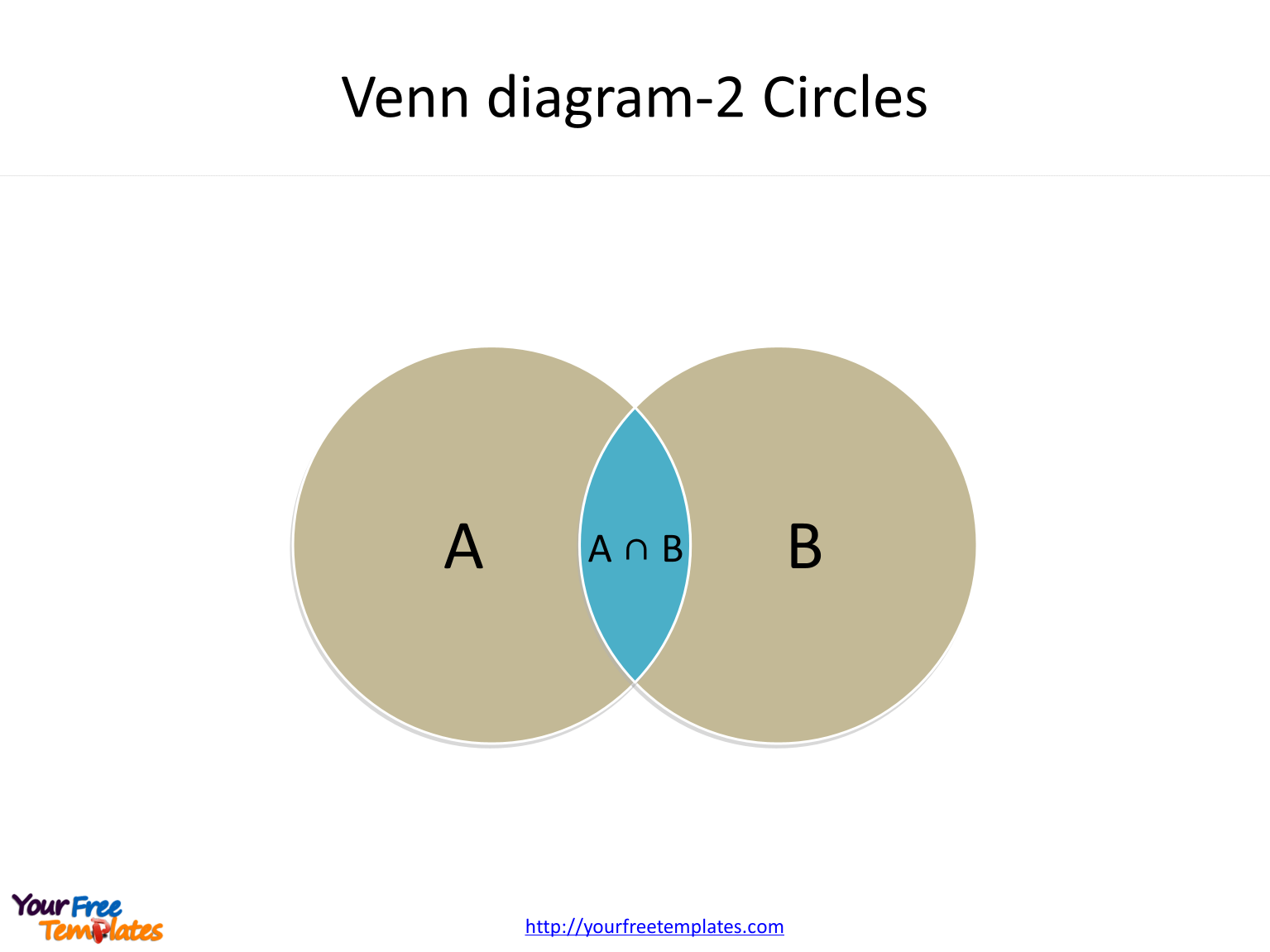
Using the famous Venn diagram:

Venn diagram

P(head or tail) = P(head) + P(tail) – P(head and tail) = P(head) + P(tail) = 1

Here we only care about the result: P(head) + P(tail) = 1.

For a fair coin, we would say that it has an equal chance to get heads and tails. That is P(head) = P(tail). So we can easily calculate that for a fair coin, P(head) = P(tail) = 0.5. 50% chance head, 50% chance tail.

That concludes the basic concepts of probability. Before we proceed, we will need another concept, conditional probability. It is usually denoted as P(A | B). It reads as the probability of A given B. That is, what is the chance of A occurring if we know that B has already occurred. From the Venn diagram above, we can see that

\large P(A\;|\;B) = \frac{P(A\;and\;B)}{P(B)}

To give the reader a little more intuition, thinking about we are randomly taking a point from the diagram above. If we know that the point must be in circle B, what is the probability it is also in the circle A? If we sample the point uniformly, we can use the area for the calculation that is P(A | B) = Area(A and B) / Area(B). If we divide both top and bottom by the Area of A or B, we have

\large P(A\;|\;B) = \frac{Area(A\;and\;B)/Area(A\;or\;B)}{Area(B)/Area(A\;or\;B)} = \frac{P(A\;and\;B)}{P(B)}

For the purpose of the following discussion, the only thing the reader needs to remember is the conditional probability equation, otherwise known as Bayes rule:

\large P(A\;|\;B) = \frac{P(A\;and\;B)}{P(B)}


Hypothesis Testing (or P – Test)

Now let’s say that we have a coin, we want to test the following hypothesis:

The coin we have is unfair.

But how can we “prove” our hypothesis? Hypothesis testing (or p – test), uses a method called reductio ad absurdum. It is a fancy Latin phrase, but we all have used it in argument sometimes, even though we may not realize it. It’s more commonly known as proof by contradiction. For example, your friend makes a bold claim, that “All ravens are black!”. So to prove that he/she is wrong, you go to the wildness, spending 7 days and 7 nights, finally found a white raven, and returns triumphantly, showing that your friend claim is wrong. But in the case of a coin, how can we know that if the coin is fair or not by simply flipping it? As long as the chance of head or tail is not zero, any sequence of outcomes is possible. This shows the first problem with Statistical hypothesis testing:

In contrast to traditional prove by contradiction, statistical hypothesis testing does not tell us that our hypothesis is wrong, just that it is unlikely (by some measure).

Keep this in mind, that an unlikely event can still happen. Statistical hypothesis testing does not tell us anything for certain, most importantly, it does not tell us, that the hypothesis is true.

Instead of seek to contradict our hypothesis, for statistical hypothesis testing, we actually seek to contradict a null hypothesis. It is just a fancy name, means the opposite of the hypothesis. Because our hypothesis is:

The coin we have is unfair.

The null hypothesis is:

The coin we have is fair.

Notice that the hypothesis and null hypothesis must be mutually exclusive and complimentary, which means one of them must be true, and they can not be both true. (The same holds also for the head and tail outcome of a coin flip. They can not be both true, and one of them must be true). In probability terms:

P(hypothesis) + P(null-hypothesis) = 1

P(hypothesis and null-hypothesis) = 0

So, to show that the null hypothesis is unlikely, we flip the coin 5 times. We got 5 heads! The p-value is defined as:

p-value = P(data | null-hypothesis)

So in our case, the null hypothesis is that the coin is fair and the data is 5 heads in 5 flips. We can calculate our p-value as 0.5 * 0.5 * 0.5 * 0.5 * 0.5 or 3.125%. Usually, we choose 5% as our threshold (it is an arbitrary choice) and say we reject the null hypothesis.

But wait, the p-value is the probability of the data, says nothing about the probability of the null hypothesis itself. Why should we reject the null hypothesis solely based on the unlikelihood of data? Well, we shouldn’t. We should reject the null hypothesis based on the unlikelihood of the null hypothesis itself. Here, we can use the Bayes rule:

\large\begin{aligned}P(null\textnormal{-}hypothesis\;|\;data) &= \frac{P(null\textnormal{-}hypothesis\;and\;data)}{P(data)} \\ &= \frac{P(data\;|\;null\textnormal{-}hypothesis)P(null\textnormal{-}hypothesis)}{P(data)}\end{aligned}

The formula above shows a problem, that the experiment tells us p-value that is P(data | null-hypothesis), but we have no idea P(null-hypothesis) or P(data) is. So, I am going to make up some data here, as scientists sometimes do. Let’s say that I have examined all of the coins in this world and 99% of them are fair, i.e. P(null-hypothesis) = 99%. And I have flipped enough coins many many times that I can confident to say that P(data) = 3.125%. It is not a surprising number, as that we have established that most of the coins in this world are fair, so the chance of getting 5 heads in a row with a random coin, is about the same as the chance of getting 5 heads in a row with a fair coin.

We can calculate the probability of the null hypothesis given the data now:

\large\begin{aligned}P(null\textnormal{-}hypothesis\;|\;data) &= \frac{P(data\;|\;null\textnormal{-}hypothesis)P(null\textnormal{-}hypothesis)}{P(data)} \\ &= \frac{3.125\% * 99\%}{3.125\%} = 99\% \end{aligned}

So, we see that even though p-value says that the probability of data given the null hypothesis is very unlikely, but we can not conclude that the null hypothesis itself is unlikely given the data! That is, we can NOT say that our original hypothesis is likely to be true! I can’t stress the following statement enough:

p-value does not and can not inform us about the likelihood of our hypothesis


Reproducibility

What can tell us the likelihood of our hypothesis is reproducibility. In this section, I will show how reproducibility provides us with insight into the correctness of the hypothesis, and it is not peer review or experts’ claim, but ultimately reproducible results that ensure the validity of scientific hypotheses.

Mathematically speaking, reproducibility increases the empirically observed probability of the data, we denoted P(data). The key reason that the small p-value did not translate to a small likelihood of the null hypothesis, in the equation above, is that P(data) is really small. Reproducibility is evaluated by P(data). A perfectly reproducible result will have P(data) = 1. For the sake of argument, 90% of people were able to reproduce our result, i.e. P(data) = 90%. Putting the number to the equation above, we can recalculate the likelihood of our null-hypothesis.

\large\begin{aligned}P(null\textnormal{-}hypothesis\;|\;data) &= \frac{P(data\;|\;null\textnormal{-}hypothesis)P(null\textnormal{-}hypothesis)}{P(data)} \\ &= \frac{3.125\% * 99\%}{90\%} = 3.4375\% \end{aligned}

Furthermore, we know that P(null-hypothesis) is always less than 1. So we can drop it in our calculation to get an upper bound:

\large\begin{aligned}P(null\textnormal{-}hypothesis\;|\;data) &= \frac{P(data\;|\;null\textnormal{-}hypothesis)P(null\textnormal{-}hypothesis)}{P(data)} \\ &< \frac{P(data\;|\;null\textnormal{-}hypothesis)}{P(data)} \\ &= \frac{3.125\%}{90\%} = 3.472\% \end{aligned}

That is, given the data, our null-hypothesis is only 3.472% likely to be true. Or alternatively, our hypothesis is 96.528% likely to be true. For those who are familiar with Bayesian statistics, P(null-hypothesis) is called a prior. But it is shown here, with good reproducibility, the prior has a very small influence towards our confidence in our hypothesis. The prior, that is our existing bias towards the likelihood of the hypothesis, has little to none influence on our conclusion about our hypothesis when we are conducting sound science. After all, scientific discoveries should be objective and do not depend on our individual prior beliefs.


Most scientific studies, of course, would involve more complex data, and more sophisticated models. But regardless of their sophistication, they are still subject to the same issue: Without being reproduced, we can not make probability claims about the data, i.e. P(data), with a sample size of one, and by extension, the validity of our hypothesis, no matter how much we feel that hypothesis is true, or how much sense that hypothesis makes.


Epilogue

Scientific theories are made and evaluated by humans, they are also as fallible as we are. I think that a good education should aim to arm us with the tools that we need to judge the validity of the information we encounter, not to enable us to be another cog in this gigantic economic machine, or at least, not simply so. It may be difficult, but I think it is crucial for each of us to, at least try to, not only look at the conclusions we read on the news, but also look at the data they provided, and how the data was gathered, and apply our own reasoning to see if we can draw the same conclusion using the data. And if our conclusion is not the same, we should also try to identify why. It is a lot of work for every piece of information we encounter. But in a digital age, that we can both so easily get information, but also share them to thousands of people at ease, I think it is important, for our epistemological responsibility, not only to verify the information we acquire, but also to do our best to prevent the spreading of false ones.

As a final note, I want to say that science only tells us the correlation between observations. It does not and can not tell us why. Newtonian mechanics tells us the relationship between force and velocity, but it does not tell us why does the force change the velocity. Quantum mechanics tells us the relationship between the wave function and the observed distribution of the particles. This is also true to other scientific theories. They only tell us about the relationships of different observations. As for the why, that is all human interpretation and our attempts in making sense of the world. I hope that the reader can keep that in mind when reading about any scientific works.


Question 1. A smart reader would probably realize that any sequence of 5 coin flips (HTHTH for example) of a fair coin is 3.125%, which means any sequence will be statistically significant. Does that mean any sequence can be used to justify that the coin is not fair? I will leave the question for the reader to contemplate.

Question 2. Per Karl Popper, a key component of scientific method is falsifiable, that is, for scientists to try their hardest to disprove their hypothesis. Shouldn’t we seek to reject our original hypothesis, instead of the null hypothesis? Or is p-test seek to confirm our hypothesis instead of falsifying it?

COVID-19

As of today 11th February 2020, a total of 40,554 cases of COVID-19 have been confirmed including 909 deaths. COVID-19 fear has caused global traffic ban into, and city lockdown within China.

COVID-19 certainly is a very serious epidemic, as my family lives in China, I found my self constantly looking for news and updates on this subject. But it is so frustrating that most of the news I found only reports what the conclusion of the experts or authorities was, rarely how was the conclusion was drawn. So, I have gathered some information I can find online from research papers to news agencies in the hope of filling in some of the gaps.

What is COVID-19?

COVID-19 is the disease caused by severe acute respiratory syndrome coronavirus 2 (SARS-CoV-2 for short). According to the work “A pneumonia outbreak associated with a new coronavirus of probable bat origin” by Zhuo et. al, SARS-CoV-2 has genetic similarities to SARS-CoV (79.5%) and bat coronaviruses (96%). I don’t currently have access to the paper, so I can’t tell what’s the metric of similarity was used for the measurement. But we can’t draw any conclusions that if SARS-CoV-2 comes from bat coronaviruses or not. As humans are 99% genetically similar to monkeys, and we know now that humans are most unlikely to be evolved from monkeys. (We really should stop using the March of Progress in our biology textbooks.) Also, the genetic sequence change of single-stranded RNA is very different from double-linked DNAs.

Based on the work “Severe Acute Respiratory Syndrome Coronavirus Sequence Characteristics and Evolutionary Rate Estimate from Maximum Likelihood Analysis” by Salemi et. al, a study of the SARS-CoV virus that was responsible for the SARS outbreak in 2003, they have identified 21,333 nucleotides, 63 sites with at least one sequence with a different nucleotide, and only 10 sites with phylogenetically informative on SARS-CoV. Based on the samples they have, they have estimated 4 × 10⁻⁴ nucleotide changes per site per year. It would suggest that SARS-CoV RNA is fairly stable. If we assume that SARS-CoV-2 shares similar RNA stability. Then we can use the RNA sequence to identify COVID-19. But how much accuracy would it require to be? Just like other organisms, SARS-CoV-2’s RNAs are not identical from one virus to another. For a human, that number has been established to be 99.9%.

I have found a couple of research papers on RNA sequencing, for example, “A complete protocol for whole-genome sequencing of virus from clinical samples: Application to coronavirus OC43” by Maurier et. al, and “Rapid Sequencing of Multiple RNA Viruses in Their Native Form” by Wongsurawat et. al. They claim that sequencing accuracies are between 99% and 94%, and 97%, respectively. (Which puts the similarity we draw between bat coronavirus and SARS-CoV-2 uncomfortably in peril).

So the only way to be certain that a patient has contracted COVID-19 is to isolate the virus from the infected tissue and sequence the RNA and comparing it with the sample sequence that we categorized as the COVID-19 virus. A common RNA test is called the nucleic acid test (NAT). Polymerase chain reaction (PCR) is one type of NAT test. Based on the work “Review: Diagnostic accuracy of PCR-based detection tests for Helicobacter Pylori in stool samples.” by Khadangi et. al, the Helicobacter Pylori PCR test had a performance of 71% sensitivity and 96% specificity. This means that 328 samples they have studied, 26 of which have been diagnosed with Helicobacter Pylori. The PCR test detected 71% of 26 diagnosed patients as positive, and 96% of the rest as negative. But I was unable to find any research in the accuracy for RNA tests for coronaviruses (In the example above, Helicobacter Pylori is a bacterial infection, not a viral infection.).

Leave the question about what ground truth and the accuracy aside, RNA tests are expensive and take a long time to finish. A couple of weeks back, COVID-19 was diagnosed clinically using the lab tests on the patient’s nasal or throat mucus samples. But the recent discovery of the test accuracy issue and the massive amount of patients in need of the test, the clinical diagnosis has changed from lab tests to symptomatic tests. That is, when a patient has a subset of a collection of symptoms, they will be diagnosed with COVID-19. The number of confirmed cases in China has almost doubled last week. The collection of symptoms are: fever, cough, shortness of breath, low blood oxygen level, shadows in CT lung scans, etc. But those are also the symptoms of other viral pneumonia cases. I do not wish to conflict correlation with causation, but I am not sure that if the increased confirmed cases are caused by the change of diagnostic standards. It also leads to an epistemological problem: if we can not have high confidence in which patients are contracted COVID-19, using the samples of those patients as ground truth for serology or NAT test would further increase that inaccuracy. (From an epidemic point of view, symptomatic diagnostics may contain a large number of false positives, but to prevent the spread of the pandemic, sometimes it is better safe than sorry.)

I am certain that COVID-19 is a new strain of the coronaviruses that can trigger acute respiratory distress syndrome, in severity, can be fatal. But I am also found myself struggling with my confidence in the statues reported on the news outlets encountered on the internet. I found it is so difficult to differentiate the conjunctions about this outbreak from tested theories. As those tests based on statistical analysis to only establish correlation from the sampled data, it is easy for us to form up theories in attempts to explain the data. In the information age, it is so easy for us to share news, thought, and our interpretation of the situation. But every incorrect guess we put out there based on our incomplete data, increases the misunderstanding of the general public, and may even mis-influence the policies that were put in place.

It is so crucial for us to be able to differentiate data from theories formed around the data, and theories formed around the theories that formed around the data. Clinically diagnosed patients may or may not actually be contracted with COVID-19. The actual number of patients who are contracted with COVID-19 is difficult to estimate, without knowing the sensitivity and specificity of the diagnostic tests. The increase in the number of diagnosed cases in the past couple of weeks may not be due to the spread of the diseases, but the changes in the diagnostic tests.

I hope that everyone stays healthy and safe during this outbreak. But also, when we saw another update about the outbreak, let all of us doing a little research before sharing it with others. The correct information is important for making correct decisions. As we share the world and the crisis together, let us also accept our epistemic responsibility.


P.S. It is easy to make conjunctions. It is hard to present evidence that supports the conjunctions made. It is extremely hard, if even possible, to show that the evidence presented can unambiguously prove the conjunction. Maybe it is a fevered dream to ask for sufficient evidence in a world with so much ambiguity, uncertainty, and unknowns.

Free Will.

I am not sure if I am alone in this. But I am haunted by a constant fear. The feeling that it is possible that my thoughts may not be mine.

At work, a common task I have is to use Newton’s method to find a minimal of a given function. But last week, I had a strange realization, that I have absolutely no justification why it would ever work. Not to bore reader with the mathematical details, but Newton’s method was only proved for convex functions, a very special type of functions. But yet, I was so convinced that Newton’s method would always give me the answer I was looking for. Lack of better a description, it just feels right to use it. But in reality, the reason that it feels right to me, most likely is that this is the method that was taught to me in college, and it is the method that is used in a lot of research papers that I read. In a way, that my choice of using Newton’s method isn’t really mine, but of my professor who taught me to use it in college, and of those authors of the aforementioned research papers, albeit unintentionally.

We all have those strange feels-right moments. The moments that we so believed that our judgement is true but we can’t really tell exactly why. It is often easy conclude then those judgement is universal or innate. But the truth is, complicated.

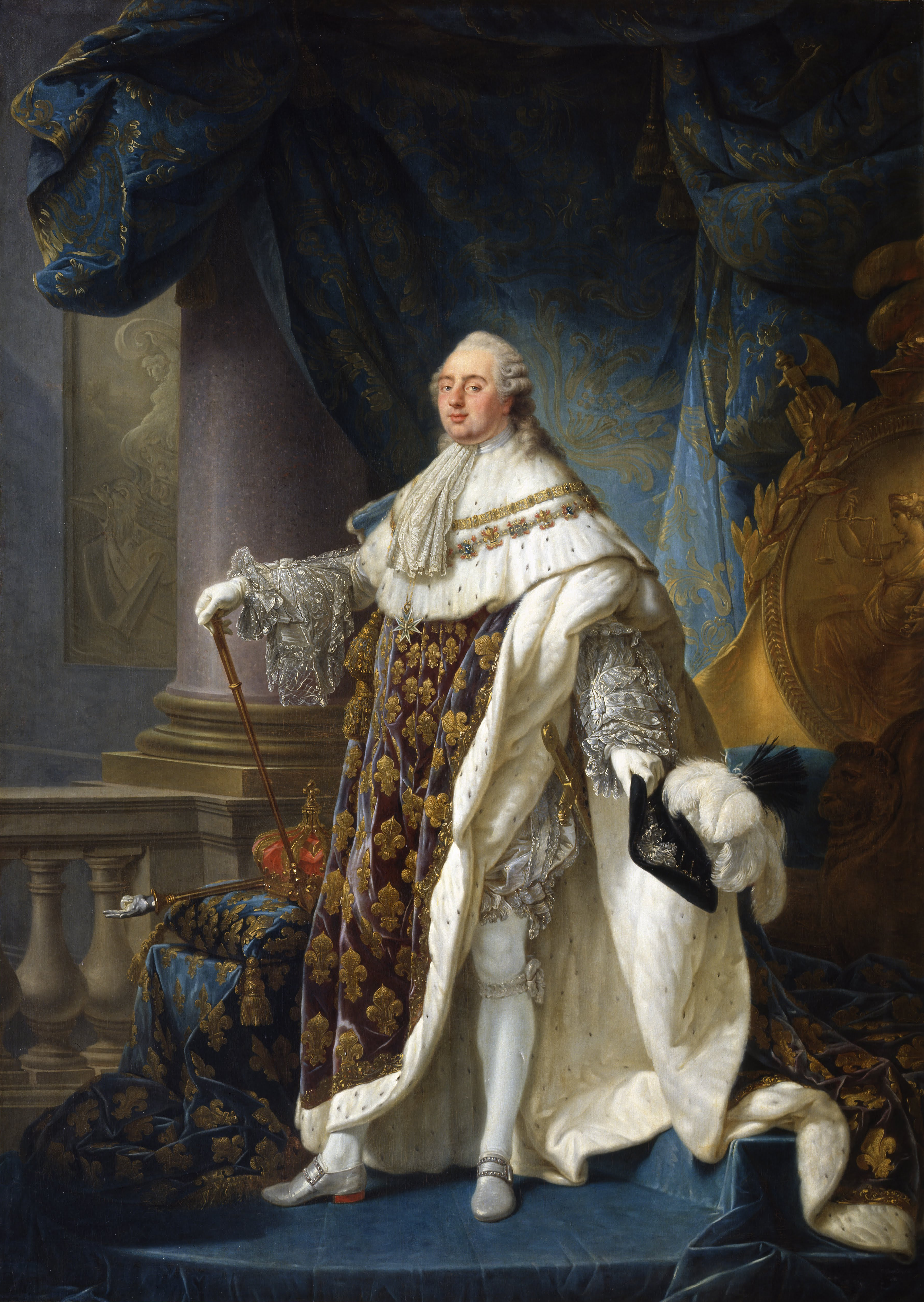
Taking physical attraction for example, most of us probably have an image of an ideal attract male looks like, which we associate with muscularity and an ideal female looks like, which we associate with femininity. And images of different people may share a lot of similarities, for example, height, body type, and facial features. It would be easy to conclude that there exists an universal agreed idea of muscularity and femininity. But if we zoom out in time, and look at the portrait of the french King Louis XVI, who is arguably the most muscular figure in the 18 century French. In the portrait, King Louis XVI wore tights, heels, and makeup, which are not the markers of muscularity in our society. It reminds us that gender construct may not as fixed and universal as we think it is. In reality, it is most likely that our idea of physical attractiveness comes from social expectation. Nowadays, mostly in the form of TV shows (I guess they are called internet series now) and movies. So, in a way, even who we decide to date, is not really our own choice.

But this does not just apply to the idea of physical attraction, but also to our idea of what to value, how we measure success, and what and whom we consider as great. Whether we value individual happiness and benefit or the interests of the collective, or if we measure success based on money or fame, what we desire and want to be in this world is deeply shaped by the world itself. As it is always important to examine what we value and why are we valuing them.

More profoundly, we have grown incredibly skilled in manipulating our own subconscious. From what ads we see only and where we see them, to the product placement and pricing in supermarket shelves, we have invented a whole field of consumer physiology to manipulating our decision making without us knowing it. I do not know if I can ever be rid of my fear and escape the influence of everything around me. But at least, with a more examined life, hopefully I can defend my actions using beyond just my feelings.

But I still think this reality is also a genuinely hopeful one. It reminds me that the world is also capable of change. Just the world shapes how we think and what we value, how we think and what we value can also shape the world. We don’t have to accept that a person’s success is measured by his wealth, or that our primary goal in life is to fulfill our personal happiness. By imagine a different world, we can live in a world that is of we choosing, instead of letting the world choose who we are.


P.S. I have been asked the question: “what decides a person’s value?” I think, just like everything else, we give something value, when it is important to us. But if the question is: “what, in my opinion, decide my value?” This is a question that different people would certainly give different answers. And different people in our lives would also have different opinions about how we should live our lives. But to me, my value is not decided by how other think of me, nor is it decided by how I think of myself. It is weighted by how I treat others. We all suffer from a terrible curse, that we can never perfectly communicate our subject experience to each other even with the help of language and art. As a result, we will always be the protagonist in our own story. Other people will never be as important as we are in that narrative. It is not hard to recognize our own importance. But it is tremendously more difficult and rare to give other people in our lives the same weight. But just like everything else, isn’t that rarity is one of the important factor for deciding values?

What are arguments and how to make them

As humans, we engage in arguments all the time. To many of us, an argument is simply a collection of sentences that tries to make a point, which is not a bad definition. But to be a little more concise:

An argument consists of premises and conclusions.

Premises are the collection of statements that the speaker regarding as true and does not need to provide support. (We can certainly always asking why those premises are true, but we will soon realize that keep pulling that thread will lead us into an endless chase. As I have discussed last week, in scientific fields, it is the norm to take certain statements to be true, not because we have proven them to be true, but rather we have yet to find empirical evidence to contradicting them).

Conclusions are the collection of statements that the speaker proves (or tries to prove) to be true, using the aforementioned proposed premises.


Before I go continue, I want to point out that the meaning of the word “true” is very nebulous in our daily language. But in mathematics, (handweavingly speaking,) the word true means one statement does not have a contradiction with another statement. If a statement is self-consistent (as most statements are), we can consider it as true (without the need of any justification) and use it as a premise. Notice that a statement can be both true and false at the same time. In such case, we will say that it is inconsistent. Just for fun, an example of a self-contradicting statement (or a paradox) would be:

This statement is false

From now on, when I use the word true or false, I will try to state what I mean. But as my discussion from On Science and Logic, It is a lot easier to prove a statement in a system (I will discuss more what a system is later) to be false, than to prove it to be true. If exists one contradiction statement in the system to the one we are examining, we may conclude that the statement in examination to be false, while to prove a statement to be true requires to demonstrate that the given statement is consistent with all the statements in the system.

Reader might also notice that truthhood can be a unearned status, we can say that something is true if we just want it to be true (but, of course we can also prove something to be true through formal logic).


Now, back to arguments. Here is an example of an argument (A):

All humans are mortal
I am a human
Therefore, I am mortal

The statement “All humans are mortal” and “I am a human” are the two premises that we took as true. “I am mortal” is the conclusion.

But, there is, actually a third premise in the argument above that we often overlook, that is the inference operator:

If all members of a group have property A, any member of the group has property A

The premise above may seem trivial, but without it, we can not infer the property of an individual from the property of the group.

Here is another example of an argument (B):

Some humans are mortal
I am a human
Therefore, I am mortal

We have noticed that both “Some humans are mortal” and “I am a human” are “true” “premises” (unless my parents have not told me something). Here, I am using the word “true” for the meaning of matching our empirical understanding of the universe. “I am mortal” is a true conclusion. But this argument may sound fishy to some readers that’s because, by making this argument, we are adding a third premise for inference:

If some members of a group have property A, any member of the group has property A

Anyone who has learned about set theory in their math class would point out that the premise above is false. But actually, because it is a premise, and we accept the premise to be true. It can’t be false. In fact, if we list every statement we have used in argument (B):

Some humans are mortal
I am a human
If some members of a group have property A, any member of the group has property A
I am mortal

There is no contradiction in the system (I will elaborate more on its definition later) composed of the four statements. So what is going on?

Let’s take a look at the argument (C):

Some mammals are cats
I am a mammal
If some members of a group have property A, any member of the group has property A
Therefore, I am a cat

I have simply replaced the word “humans” with “mammals“, and “mortal” with “cat(s)“. So following the same structure, we can conclude that there is also no contradiction in the argument above. In fact, there is no contradiction in the argument above. But when we think that the conclusionI am a cat” is False, what we really think is that the conclusion contradicts the empirical evidence. So, when we add empirical evidence to the collection of statements, we now have an inconsistent system:

Some mammals are cats
I am a mammal
If some members of a group have property A, any member of the group has property A
I am a cat

Empirically, I am not a cat

The examples above also show that it is easy to create a consistent system of statements with some empirical evidence (often, what psudo-science trying to show). But, it is really really hard to create a consistent system of statements with all empirical evidence (what scientific method tries to show).

So, instead of saying something to be true or false, maybe what we really want to say is if it is consistent or inconsistent.

Now I can give a formal definition to what a (formal) system is:

A formal system is the collection of the selected premises, and all the conclusions can be drawn from the premises.

It is important that a formal system must include all the conclusions. We can’t pick and choose what is in the system. For example, if I exclude the conclusionI am a cat” from argument (C) which leads to the following collection of statements:

Some mammals are cats
I am a mammal
If some members of a group have property A, any member of the group has property A
Empirically, I am not a cat

There is no direct contradiction in this collection of statements, but the formal system is still inconsistent because we can draw a conclusion that is inconsistent with one of the premises.

One pair of consistent statements, even 1,000 pairs of consistent statements can not show that the formal system is consistent, we will need to show that all pairs of statements are consistent. But only one pair of inconsistent statements is needed to show that the formal system is inconsistent. We can’t pick and choose what conclusions to include the system to make it consistent.


So, when we disagree with someone’s argument, it can be one of the two reasons:

  1. Either we think their formal system of beliefs is inconsistent within itself.
  2. Or we think their formal system of beliefs is inconsistent within ours.

If we think someone’s formal system of beliefs is inconsistent within itself, we can construct a case using only statements from their system (without adding any premises of our own) to show such inconsistency. If the interlocutor cares about having consistent beliefs, he/she would be grateful for this counterexample.

If we think their formal system of beliefs is inconsistent within ours. Before we start criticizing others’ choice of premises, remember that premises are statements that we have taken as true, our choice of premises are just as valid (or invalid) as their choice. By choosing what lens we look at the problem through, we can see it in different colors. Maybe no perspective can give us a whole picture of every problem, but many of them can reveal different and important information. Remember, what we think is wrong in others’ premises, is exactly what they saw wrong in ours.

But first, let us examine if our own system of beliefs is consistent. In the next post, I will discuss Gödel’s incompleteness theorems and what happens if we do not have a consistent formal system of beliefs.


P.S. I want to use the postscript to talk a little about formal logic and informal logic. Formal logic is deductive reasoning that is defined in mathematics and has not contradicted by empirical evidence. “If all members of a group have property A, any member of the group has property A” is an example of formal logic, defined in set theories. Informal logic is reasoning that we use that sometimes will contradict by empirical evidence. “If some members of a group have property A, any member of the group has property A” is an example of informal logic. There are two commonly used informal logic inferences: inductive inference and abductive inference.

Inductive inference is generalization (not to be confused with mathematical induction). For example, if I observe one duck be white, and a second duck to be white, then I conclude that all ducks are white, which is inductive inference. Readers can very easily find cases that using inductive inference will lead to conclusions that contradict the empirical evidence.

Abductive inference is the process of elimination. When we have eliminated all the impossible, what remains, how improbable, must be the truth. But in reality, there is often an infinite number of possibilities, and we can rarely eliminate all the impossibles.

So, informal logic is inconsistent with empirical evidence. Therefore any system that includes both informal logic and empirical evidence is inconsistent. But informal logic is also extremely useful, scientists often use them to form up hypotheses, but then design experiment and use formal logic to test them. (Note, in this case, informal logic is not included in the system, only the proposed hypotheses, and we can test if it is consistent with empirical evidence).

On Gödel’s Incompleteness Theorems


Introduction

As a couple of people has pointed out that the conclusion I have drawn from my last post On Science and Logic, shares some similarity to the Gödel’s Incompleteness Theorems, I have learn about it this week for the first time. It is only the 2nd week of the new year, but is certainly the most fascinating thing that I have learned this year!

Some of the information that I am about to present in this post is taken from Undefined Behavior‘s Youtube channel, linked at the end. In those videos, Undefined Behavior has concisely and clearly presented the concept and a scratch proof based on the halting problem. If the reader wish to learn more about the details and proofs of Gödel’s Incompleteness Theorems, I recommend his videos.

In this post, I will skip the proofs of the theorems, as there are already great existing sources on this subject. I will take Gödel’s Incompleteness Theorems as proven true from here on.

In this post, I will use concepts such as the formal system. If the reader wants an introduction to those concepts, here is a link to my previous post: What Are Arguments and How to Make Them.


From the very beginning of human history, we have accepted our ignorance, that there are much knowledge in the universe we have not yet acquired. But many holds the belief (and many still) that with the progression of scientific discovery, we can ultimately have an answer to every answerable question. That is, until Kurt Gödel and his 1931 paper.


Gödel’s First Incompleteness Theorems:

Any consistent formal system F within which a certain amount of elementary arithmetic can be carried out is incomplete; i.e., there are statements of the language of F which can neither be proved nor disproved in F

To put it in a more commonly understandable language: in mathematics, there are certain statement, can neither be proved or disproved, if the logic system we use is consistent (please refer to my previous post for what does consistent mean). It is difficult to describe the impact of this theorem. Before then, many philosophers, who often are also mathematicians, believed that the only certain knowable thing is mathematics. This discovery has turned the world of mathematics upside down, as it proved that certain mathematical statement is just unprovable.


Gödel’s Second Incompleteness Theorems:

A consistent formal system F, the statement that F is consistent, is not provable.

To me, mathematical theorems have a strange sense magical realism as Gabriel Márquez delivered in his masterpiece of a hundred years of solitude. Mathematical theorems are often stated in a plain tone, simple and seemingly unremarkable. But so many of them has transformed our understanding of the universe. From Newton’s formulation of calculus (or Leibniz, depends on your perspective), to Schrödinger picture for quantum mechanics, each discovery accompanied great shifts in our understanding of the universe. In this case, Gödel had left us with a true dilemma:

As much as we hope that to be consistent, we may never be able to prove its consistency, and we shall hope is that we can never prove that it is consistent.

Why does it even matter to be consistent? To answer this question, I will take the following example from Undefined Behavior:

Considering the following two statement –

A. No pig can fly.
B. Some pigs can fly.

Those two statements are complimentary and mutually exclusive, which means that in a consistent formal system, one and only one of them must be true. But for a inconsistent formal system, they can be both true. Using Boolean notation:

B = NOT A

Now consider a third statement –

C. Unicorn exists.

We know that A is True, so C or A is True. Because B (NOT A) is True, combining with the fact C or A is True, C must be True.

This strange logic algebra has lead us to conclude the existence of unicorn using the facts about pigs’ ability to fly. This example is constructed to be absurd to demonstrate how easy it is for us make conclusions when we are inconsistent.

In a world where Orwell’s pig is right, that “all animals are equal, but some are more equal than the others”, everything is true. But also, nothing is true.

So, let us hope, for our own sake, that we are consistent in our values and beliefs even though we might never find it out.


The end of man is knowledge, but there is one thing he can’t know. He can’t know whether knowledge will save him or kill him.

― Robert Penn Warren, All the King’s Men

Grocery Store and Windstorm

It has been my routine for a while now. I live very close to a grocery store. Once or twice a week, I would go out for a run, stop by the grocery store get some food and bring them home. I have lived in the States for a long time now. Visiting those gigantic grocery stores has become somewhat mundane or even boring to me.

Last week, when I was bored in the store, just as any normal people would do, I did some math. If I consider to eat two to three meals a day, or approximately 2000 calories. Each aisle of food in the store can supply me for over a year, and everything in the store can potentially sustain me for a life time. Granted, many of the food items may not provide me with a healthy life, but will sustain me nonetheless.

On Christmas eve, during dinner, my friend told me a story about her grandparents, during just before the time of WWII. People couldn’t put food on their table. Sometimes, they would run for miles after a food transport truck, hoping that some potatoes would fall off so they can bring them home to feed their family. My grandma used to tell me the story that my mom loved watermelon when she was a kid, and my grandpa would walk 20 miles so that he can get two watermelons from the neighboring town and bring them home. Queen Isabella of Castille and Spain once has given her daughter a small box of sugar as Christmas gift.

Accustomed this strange and recent material abundance, I have realized that I may never fully grasp the gravity of those stories. We don’t run so that we may have food, we run because we have too much food. Where I live, our minds are not troubled by where to find the next meal, but mostly occupied by what to do next to entertain ourselves. For this, I am incredibly lucky, living in the reality of this contemporary affluence.

But our world is also profoundly unjust.

 2.1 billion people lack of access to clean water. Estimated 925 million under- or malnourished people in the world in 2010. 3.1 million children under five every year die from undernutrition.

In this data driven, image drenched world, those numbers have lost their power to penetrate our defenses. Besides, I am just one small cog in this economical machines of 7 billion gears. Why would I bother myself with those upsetting news if I can’t do much to change it and it is so easy to surround myself with customized news feeds, and entertainments that would bring me happiness?


Last October, a windstorm swept through California. A wildfire spread around Los Angeles. It has caused over 50,000 people were evacuated their home, some of which were lost to the fire.

John Locke, the father of Liberalism, proposed that all mankind beings, all equal and independent, have a natural right of life, liberty, and property. The idea of natural rights has so deeply ingrained into our understanding of the society. We have come to expect that at time of need, we should be offered protection of those rights. We expect to be provided with access to clean water, food, electricity, and now internet.

But make no mistake, those natural rights did not come naturally. The American Revolution fought for idea of freedom. The French revolution fought for equal rights of all human. The American civil right movements advocated for the equality of all citizens. In short, we have those rights because someone had fought for them. In many ways, the fight is still going. As our ancestors has obtained those rights, if we do not continue to protect them, we can also lose them.


After all, I do think it is important for each of us to know and understand the tragedy and inequality in this world. If we do believe all human have the right to life, liberty, and property, and carry the expectation that others to offer protection of those rights in our times of needs, we should stand by our belief and help, especially those who are need the protection the most.

With the highly globalized economy and information network, we are at a point of history that everyone with the access to internet can make a profound difference to someone thousands miles way. Maybe as one person, we can’t change the world overnight. But we can change someone’s life, somewhere.


P.S. If readers are interested to know more about what is happening in this world, here are some of related video. But of course, there are so much more on the internet, just a search away.